
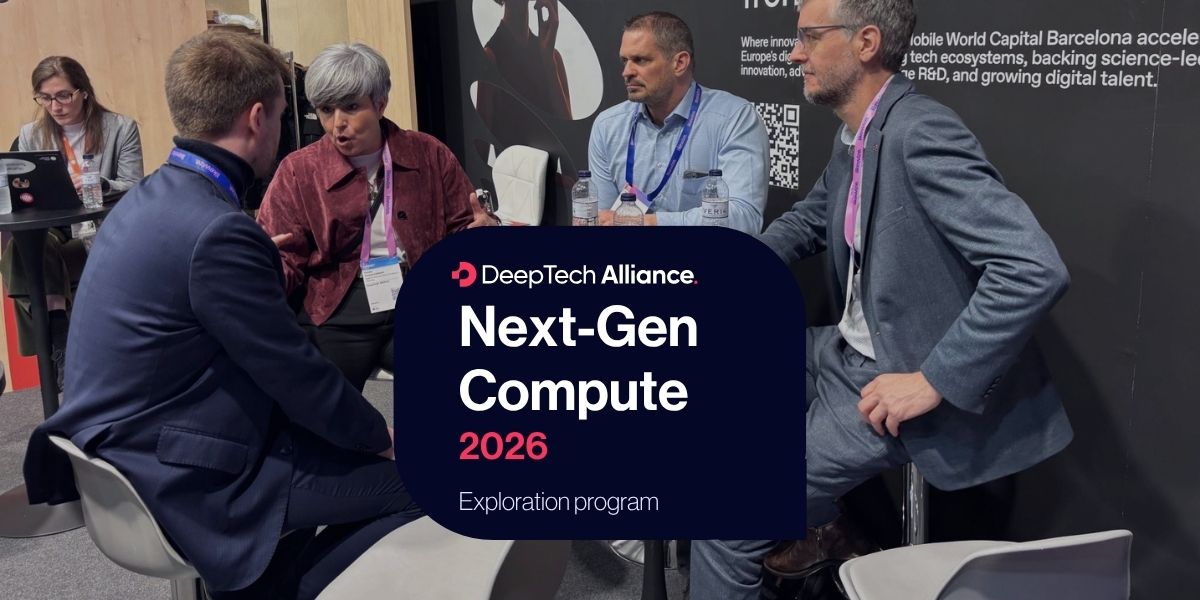
The digital landscape is on the brink of a monumental shift. Last month, as the tech world descended upon Barcelona for Mobile World Congress and 4YFN, a more intimate and strategic conversation was taking place. The first in-person gathering of the Next-Gen Compute (NGC) Exploration Program brought together corporate leaders and frontier innovators to pull back the curtain on a technology that will define the next decade:
Quantum Computing.
The goal of this program isn’t just to observe the future, but to help corporations understand and engage with it. Through targeted meetings with startups, research institutions, and investors, representatives from companies like Repsol, Moeve, IHI Corporation, A2A, and ArcelorMittal gained a holistic view of the quantum ecosystem—from the raw hardware to the investment dynamics driving it forward.
Why Depth Matters More Than Scale
In an era of massive tech conferences, the NGC Exploration Program takes a different approach. It prioritises the depth of dialogue over the size of the audience. By fostering a curated environment, the program allows for trusted exchanges and strategic learning that aren’t possible in a crowded exhibition hall. This “deep dive” approach is essential for a technology as complex and transformative as quantum computing.
Four Key Insights for the Modern Corporation
The exploration confirmed a vital truth: while large-scale industrial deployment is still emerging, the momentum is undeniable. Here are the four key takeaways for any organisation looking to stay ahead of the curve:
1. The Rise of Hybrid Architectures
The immediate future isn’t “quantum instead of classical”; it’s quantum alongside classical. Most practical applications in the coming years will rely on hybrid architectures that combine the reliability of High-Performance Computing (HPC) with the specialised processing power of quantum units.
2. Identifying Early Industrial Use Cases
The first “quantum advantage” will likely be felt in specific, high-complexity areas. Corporations should keep a close eye on:
- Optimisation: Improving energy systems, logistics, and complex scheduling.
- Materials Discovery: Simulating molecular structures for better batteries or chemicals.
- Financial Modelling: Enhancing risk assessment and portfolio management.
- Cybersecurity: Navigating the shift toward post-quantum encryption.
3. The Sovereignty Factor
There is a growing emphasis on European technological sovereignty. With increased investment from governments and research institutions, Europe is positioning itself as a central hub for quantum development. For corporations, this means a unique opportunity to collaborate with local ecosystems backed by significant institutional support.
4. The Path to Corporate Preparedness
Quantum computing may still be several years from full maturity, but the time to prepare is now. Waiting for the technology to be “finished” means falling behind. Forward-thinking companies are already:
- Identifying their most difficult computational challenges.
- Exploring “quantum-ready” algorithms.
- Monitoring the implications for cybersecurity and encryption.
Looking Ahead
The “Next-Gen Compute” journey has only just begun. By bridging the gap between today’s industrial needs and tomorrow’s computational power, we are ensuring that the transition to the quantum era is not just a leap of faith, but a strategic, well-prepared evolution. If you believe you need to get in on it, contact Natalia Alvarez Liebana at [email protected].
